
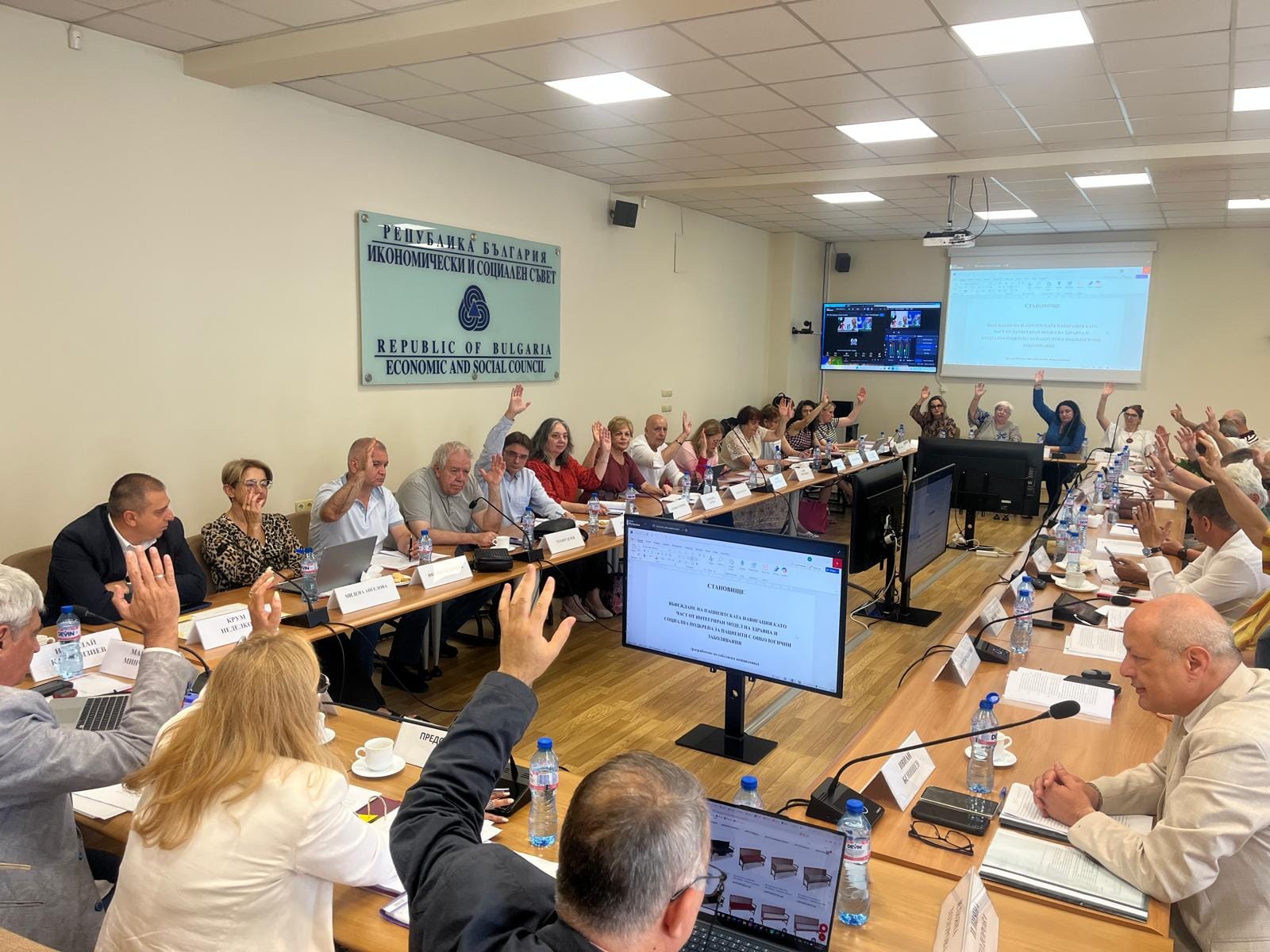
The Economic and Social Council adopted three acts, in which it makes recommendations on key issues regarding the development of healthcare, agriculture, and industry in Bulgaria.
The Council members approved the position papers “Introduction of Patient Navigation as Part of an Integrated Model of Health and Social Support for Cancer Patients” and “Reindustrialization of Bulgaria—Challenges and Opportunities, ” as well as the analysis “Water Security in Agriculture—A Strategic Priority in the Context of Climate Change.”
In these three documents, the ESC sets forth specific recommendations for improving coordination in the care of cancer patients, to ensure water security and the sustainable development of agriculture in the context of climate change, as well as to restore the competitiveness of Bulgarian industry through long-term policies and strategic investments.

Faster Diagnosis and Treatment for Cancer Patients: ESC Proposes the Introduction of Patient Navigators
The ESC Position Paper on Patient Navigation proposes the establishment of a national system of patient navigators to help people with cancer navigate the processes of diagnosis, treatment, follow-up, and social adjustment more easily. It is precisely the lack of coordination between these separate stages that leads to delays in diagnosis, postponement of treatment, interruption of follow-up, and unequal access to health care services.
A new state-funded function and legal framework for patient navigation for cancer patients are among the key recommendations of the ESC in itsadopted position paper “Introduction of patient navigation as part of an integrated model of health and social support for patients with cancer.”
The rapporteurs for the bill are Teodor Dechev from the Employers’ Group and Detelina Smilkova from the Civil Society Organizations Group.
Patient navigation can be regulated at the sub-legislative level by establishing a legal basis, by analogy with the model of health mediators. Furthermore, the position of “patient navigator” should be introduced as a new state-delegated activity within the “Healthcare” function, funded according to a standard adopted by a decision of the Council of Ministers.
In its opinion, the ESC emphasizes that patient navigation should not be viewed as an additional service, but rather as a structural mechanism that ensures continuity, coordination, and predictability of care for people with cancer.
The need for such a model is particularly relevant for Bulgaria. According to Eurostat data, the country remains among the European Union member states with the lowest life expectancy, and it is also among the few countries where cancer mortality has continued to rise over the past decade. At the same time, Bulgaria still lacks sustainable population-based screening programs for breast cancer, cervical cancer, and colorectal cancer, and patients face a number of administrative, financial, and regional barriers to accessing diagnosis and treatment. The document tracks and analyzes experiences on this topic from six European countries with different approaches.
European experience shows that patient navigation models significantly improve coordination among the various components of the healthcare system, reduce the risk of treatment delays, and limit patient dropout from the system. This is precisely why the ESC defines patient navigation as a necessary structural tool, rather than as an additional social service.
The opinion further emphasizes that the proposed model does not require a radical reform of the healthcare system, but rather represents a practical mechanism for better organizing existing processes and resources. The goal is to ensure that patients are not left to navigate the complex system of institutions, healthcare facilities, and administrative procedures, but rather to receive organized support throughout the entire process—from the initial suspicion of a diagnosis through treatment, follow-up, and social support.


Bulgaria uses only 6.5% of its irrigation potential; measures are needed to sustain agriculture
In the analysis titled “Water Security in Agriculture—A Strategic Priority in the Context of Climate Change,” adopted at the same plenary session , the ESC defines water security as a national priority on which food security, rural development, employment, and the competitiveness of the Bulgarian economy depend. The rapporteur for the resolution is Natalia Shukadarova from the Civil Society Organizations group.
The ESC emphasizes that the irrigation infrastructure, built decades ago and losing 70–80% of its water through open canals, is in critical condition, and recommends the adoption of a national program for its prioritized reconstruction and modernization. There is a drastic gap between installed capacity and actual utilization: of approximately 5.4 million decares of land suitable for irrigation, only about 6.5% is actually irrigated, meaning that over 93% of the irrigation potential remains unused. This calls for urgent and coordinated action to modernize the infrastructure and improve water resource management.
The ESC recommends the development of a National Irrigation Strategy for 2028–2038 with a clear roadmap and guaranteed multi-year funding, similar to Romania’s consistent national policy. The recommendations also include reforms in the management of “Irrigation Systems” EAD and in the Water Act, aimed at reducing the administrative burden, ensuring more effective oversight, and providing farmers with faster access to water resources. The opinion further recommends the introduction of unified water management, the digitization of procedures, the development of a national information system and real-time monitoring, as well as the promotion of water-saving technologies and the reuse of treated wastewater for irrigation.
The Council also emphasizes the need for Bulgaria to use its own water resources more efficiently, including the potential of the Danube and the southern rivers, to preserve and restore the network of small dams, and to refrain from making long-term commitments to provide guaranteed water quantities from transboundary rivers to neighboring countries.
Adapting agriculture to climate change requires a consistent government policy, coordinated investments, and sustainable water resource management, so that Bulgaria can ensure its long-term food security and the sustainable development of the agricultural sector.

The decline in industry calls for urgent action: ESC issues recommendations for Bulgaria’s reindustrialization
In its position paper “Reindustrialization of Bulgaria—Challenges and Opportunities,” the ESC outlines the main challenges facing Bulgarian industry and proposes measures to restore its competitiveness and ensure its sustainable development. The rapporteurs for the document are Milena Angelova from the Employers’ Group, Ognyan Atanasov from the Trade Unions Group, and Bogomil Nikolov from the Civil Society Organizations Group.
In the document, the ESC expresses concern over the continuing decline in industrial production and emphasizes that this trend is unfolding against a backdrop of slowing economic growth in the European Union and intensifying global competition.
The Council emphasized the need for Bulgaria to transition to an economy with higher added value by developing the manufacturing sector, the circular economy, and the production of finished goods—this requires a consistent government policy with a long-term perspective, supported by a stable energy strategy.
Bulgaria’s successful reindustrialization is a strategic prerequisite for boosting economic growth, competitiveness, employment, and the country’s prosperity, and should be accompanied by targeted efforts to strengthen Bulgaria’s national image. This includes promoting Bulgarian products under the “Made in Bulgaria” brand, which will support the integration of Bulgarian enterprises into international value chains.
The ESC notes that the processes of decarbonization and the green transition must become a real factor in boosting the industry’s competitiveness, while at the same time limiting the administrative and financial burdens on businesses. Other recommendations include encouraging investment in the modernization of production and strategic infrastructure, as well as implementing pilot projects in various regions of the country. These should support the development of education, science, transportation, healthcare, and public services, and serve as the foundation for a future national strategy.
The opinion also emphasizes the development of the circular economy through incentives for waste recycling and the use of local raw materials, investments in water efficiency and sustainable water resource management, as well as on the key role of the defense industry as a driver of technological modernization and the development of related industrial sectors.


